Review


Arts and Film — nic @ 08 Oct 2009 06:39 pm

I just posted this review on the New York Times website in response to A. O. Scott’s review

bronson

I saw this film at the recently concluded Milwaukee Film Festival, and found it one of the best movies of the festival.  It is quite violent, but as A. O. Scott notes, that violence is most operatic in presentation.

While it is easy to leap to comparisons to “Clockwork Orange,” “Bronson” aspires both to much less and in some ways more.  I found myself comparing it as much to “Chicago” and some of Davind Lynch’s oeuvre.

While director Refn romanticizes, to some degree, the violence of his subject, “The Most Famous Criminal in England,” he does not apologize for him or ever ask us to forgive him.  He lets us, to the extent we wish, view the world as Michael Peterson (later renaming himself as Charles Bronson, after the American cinema star) sees it.  Through the spectacle of the music-hall scenes we are able to experience the bizarre vision Peterson has of his own place in the world.  We witness as he progresses from the “most violent” criminal in his prison, to the most violent in England, to the “most famous” criminal in “Her Majesty’s Pleasure,” and it is with relish that Peterson climbs these imagined rungs on his career ladder.

Ultimately Peterson, played by Tom Hardy, envisions himself as a performer, with a perceived audience comprised of the nation, even though it is really just him, and his jailers, who really see what he has become.

The asterisk?  Do not see this film if you cannot stomach the highly stylized violence.  If “Kill Bill” and its cartoonish violence shocked you, then this will do worse.  If you can get past the shocking violence, you will find a gem of a performance by Hardy and a beautifully crafted film from Refn.

convert this post to pdf.
Arts and Music and Overheard in Milwaukee — nic @ 18 Sep 2009 11:25 pm

This evening Pawn found himself wandering over to The Jazz Estate on Milwaukee’s East Side for a little respite of delightful music.  The bookings read “Jeanne Woodall w/ The Jim Poalo Trio”  I have never heard them, but what the hell.

On the walk over the nice man sitting outside Beans & Barley says, “Hey white nigger!”  It’s always pleasant when strangers take it upon themselves to break the ice with a friendly greeting.

At the club, $5 cover paid, I settle into a seat at the bar and crack open my New Yorker under the dim green bulb for a little read whilst I await the trio.  The night unfolds with a wonderful journey through the mid-century songbook of American jazz.  Ms. Woodall favors Sarah Vaugn with some lovely renditions of old standards.  The pianist is inspired, Poalo on bass is steady and smooth.  Krause on drums is just the right prescription.

The arab in the corner nurses his Beck’s and speaks in resonant tones.  The hipster on the end works his Guiness and worries his mustache.  The black trombonist in the middle, his torso a short cubic yard of flesh, sipping a Cosmopolitan, the stem of the Martini glass impossibly small in his hefty mitt, mediates between them.

After two sets I strolled back home, towards Jupitor as he marches across the sky, my appetite for jazz sated for one night.  I’ll be back again soon.  I had forgotten how much I love this club.

convert this post to pdf.
Arts and Review and Theatre — nic @ 11 Jul 2009 12:54 pm

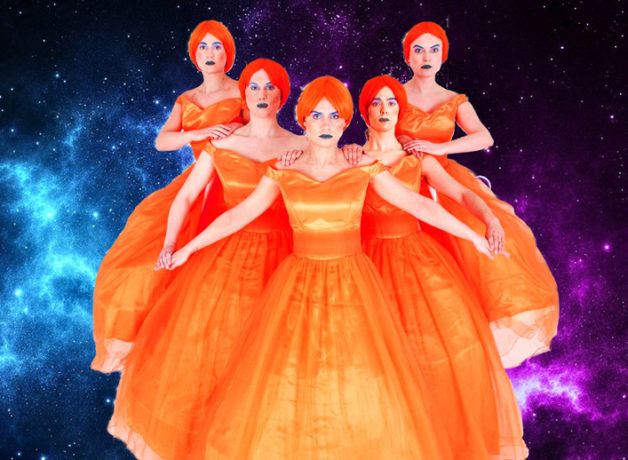
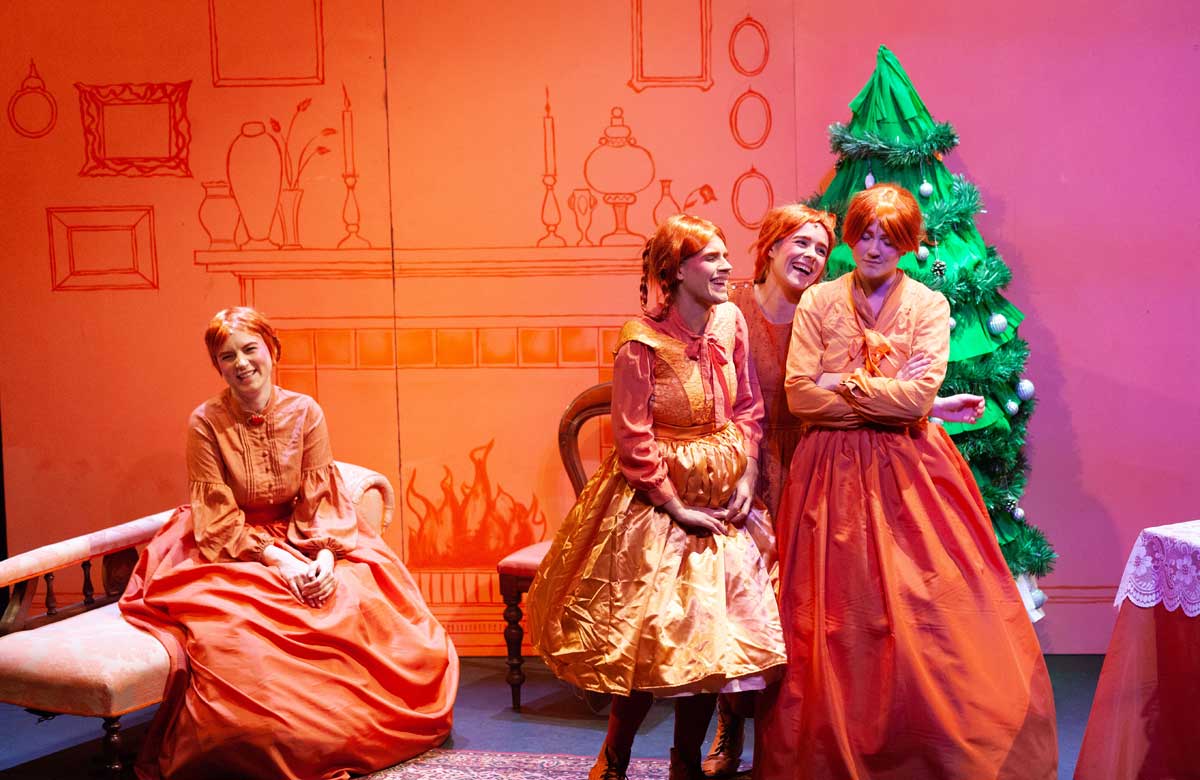
Last night found Pawn and escort at the premier performance of Youngblood Theatre’s inaugural season: David’s Redhaired Death. The script, by Sherry Kramer, is a train wreck. It is full of forward references, flashbacks, speeches to the audience, and other atypical theatrical conceits. The story has barely any narrative to it, but rather we in the audience are given stuttering glimpses into another train wreck; the love affair between two redheads, Jean (Tess Cinpinski) and Marilyn(Jazmin Vollmar).

Action begins at an open mic night. Jean takes the stage and begins the first of many speeches to the audience.   Next comes a rather twee bit about the sisterhood of read haired women and their supposedly extraordinary qualities.  This provides a thread which weaves in and out of a budding relationship between Jean and Marilyn, her paramour. David’s Redhaired Death is a production starved for silences, nowhere more than in this first third of the one-act.  Jean and Marilyn hurtle forward (and sometimes back) propelled by the fever pitch of their dialog and monologues.   You may find yourself dazzled by the rapid fire dialog, Pawn found himself numbed.

The best parts of a drama are often found in those spaces between and around the words.  We are given no such room here, neither are the actors.   They seem at times to strain against the sheer volume of text through which they must chew in any given scene.  But just as the audience is given little or no time to reflect upon the text, the characters at times seem to lack reflection as sentence after sentence spring forth from them and fall, unconsidered, onto the stage floor.

The final third of the show does bring us a moment or two of pause, as well as one truly moving scene between Jean and Marilyn.  Cinpinski and Vollmar shine in this part of the show, and the spare setting melts away from our vision as the intensity of the acting increases.  Jean’s exit speech in the penultimate scene was quite nearly profound.  Had she been allowed to slump down into one of the empty seats, taken a moment and found her motivation for continuing after the psychic body-blows she has just taken (and dealt out) this whole scene could have gone a long way towards reclaiming an otherwise problematic effort.

One hopes Youngblood continue their work, but that they consider more carefully which shows to produce and how frantically they stage them.  This production  disappoints; a defter hand could have tamed this unruly script and presented us the heart hammering story buried within it, without hammering our heads in the process.  This kind of herky-jerky forwards/backwards, repetitious, staccato, reflexive script can be rendered into a moving theatrical experience, as Pawn found with Simple 8’s production of Monsters at Arcola Theatre back in May, but not like this.

In retrospect, given some more time to consider both the script and the performance, I have tamed some of my earlier comments.  I do look forward to seeing the rest of Youngblood’s season.  If nothing else I am impressed by the sheer audacity of their repertory effort.  Also, the more I think about it, and despite its complexity, I really did like the script for DRD.  The problems in the production made that hard to appreciate at first blush.

convert this post to pdf.
Arts and Current Events and Pop Culture and Review — nic @ 12 Jun 2009 05:14 am

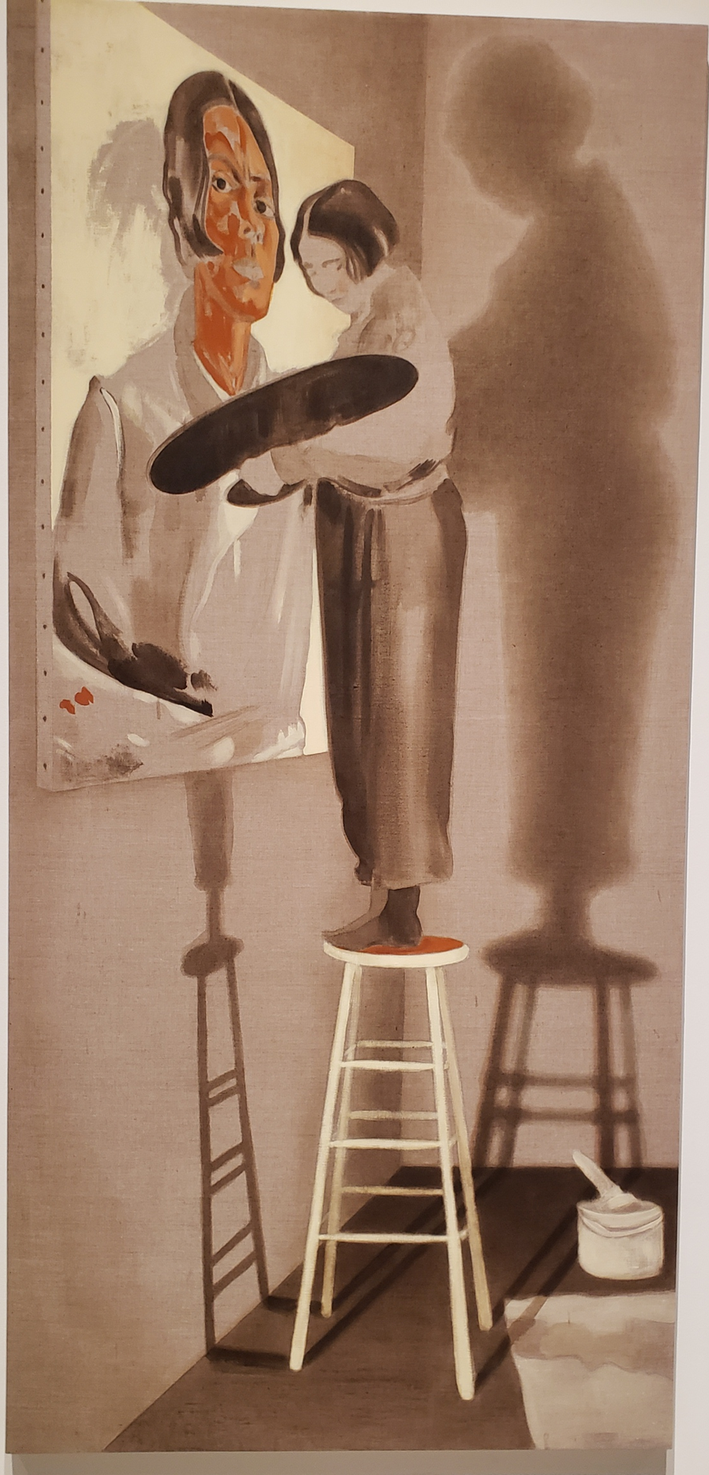
A trip to the Racine Art Museum last night provided insight into the monumental work required to exhibit monumental work.  In this case the program was the first 2009 installment of “Meet Me on the Patio,” a summer series of members and visitors events.  The subject of the program last night was Living Large – backstage at RAM, which focused, through the compelling tour discussion of David Zaleski, on the issues and labors involved with producing an exhibit like Bigger, Better More: The Art of Viola Frey, currently on display in RAM’s gallery 3.

Zaleski’s talk provided wonderful insight into the suffering of a curatorial assistant and great enlightenment as to the procedures, methods, and issues involved in dealing with any large exhibit, but especially in dealing with an exhibit of the large.  Some of Frey’s pieces are so large they may require 30 or 40 or more crates just to move.  Several semi-trailers were involved with this show, not to mention the flights back and forth for the specialists involved, the couriers, etc.

All in all a lovely evening at RAM|Art.  Programs like this are an invaluable part of the mission of any art museum, but especialy one which, like RAM, focuses on crafts and their more accessible nature.  It also engenders thoughtfulness on the part of the casual visitor when they know more of what goes on behind the scenes to get great art in front of them.

Hats off to RAM|Art and to David Zaleski for his great talk.

convert this post to pdf.
Arts and Review and Theatre and Travel — nic @ 26 May 2009 08:22 am

Nothing like a little light theatre to cap off an exceptional day of art in London.  Well, light theatre is not what the Old Vic had in store for L and I last night.  The Cherry Orchard by Anton Chekhov is currently in repertory with The Winter’s Tale by Shakespeare as part of The Bridge Project put together by Sam Mendes, director, and Kevin Spacey, Artistic Director of The Old Vic, along with Brooklyn Academy of Music and Neal Street Productions.

The large international cast includes people Americans would find familiar, such as Ethan Hawke and Rebecca Hall, as well as those familiar to Brits, such as Simon Russell Beale and Sinéad Cusack.

The script, in a new version by Tom Stoppard, is accessible and fluid.  The acting is superb and top notch.  The costumes, by Catherine Zuber were an absolute delight.  Paul Pyant’s lighting lovely.  Anthony Ward’s set, however, left me cold.  The house at The Cherry Orchard, where all of the action takes place, is as much a character in the play as anyone on stage, and yet in Ward’s set it is cold and distant.  Why, I find myself wondering, are these people so in love with this house?  I would be glad to be done with it.  Oh well, write it off to the constraints of repertory, I suppose.

It was a brilliant night at the theatre, in any event, and well worth the price of admission.  We had tenth row seats, which were a great vantage point.

I must mention the creative use of an “Aluminium Harp” by the musical team.  This instrument is basically a selection of aluminium rods of varied length and is played by the harpist sliding their resined finger tips up and down along the lengh of the rods.  This produces a ghostly continuous tone, used to great effect within the soundscape of the production.

Homeward after the show, stopped for a quick pint at the Lord John Russell before last call.

convert this post to pdf.
Arts and Review and Travel — nic @ 26 May 2009 08:00 am

A gallery favourite of mine is the Wellcome Collection. They have opened some new galleries and expanded others. Last year featured an extensive exhibition on the science and social norms of sleep. This year brings us madness, specifically Madness & Modernity: Mental illness and the visual arts in Vienna 1900 as well as Bobby Baker’s Diary Drawings: Mental illness and me, 1997-2008.

Madness & Modernity examines the role that mental illness had in the arts and architecture associated with the Secessionist movement in Austrian arts arising in Vienna at the turn of the last century.  I really took to this exhibit, which included some wonderful examples of the architecture of Otto Wagner, specifically St. Leopold’s Church:

Otto Wagner - St. Leopolds

The final church was not quite to this spec, but quite impressive.

Also featured were some of the furniture, fixtures, equipment and textiles.  I love this textile by Joseph Hoffman, called Sehnsocht or “Longing

Joseph Hoffman - Sehnsocht "Longing"

Here is some of the therapy equipment:

Mechanotherapy

There is also a large selection of artwork by patients and of patients, in The Pathological Artist and The Pathological Patron sections of the exhibit.  Here is a sample, Portrait of Lotte Franzos by Oskar Kokoschka:

Next door is the Bobby Baker diary drawings, and they are something else!  This is an exhibit that X would have loved to see, and I wish they had an exhibit catalogue that I could bring back, but alas there is none.

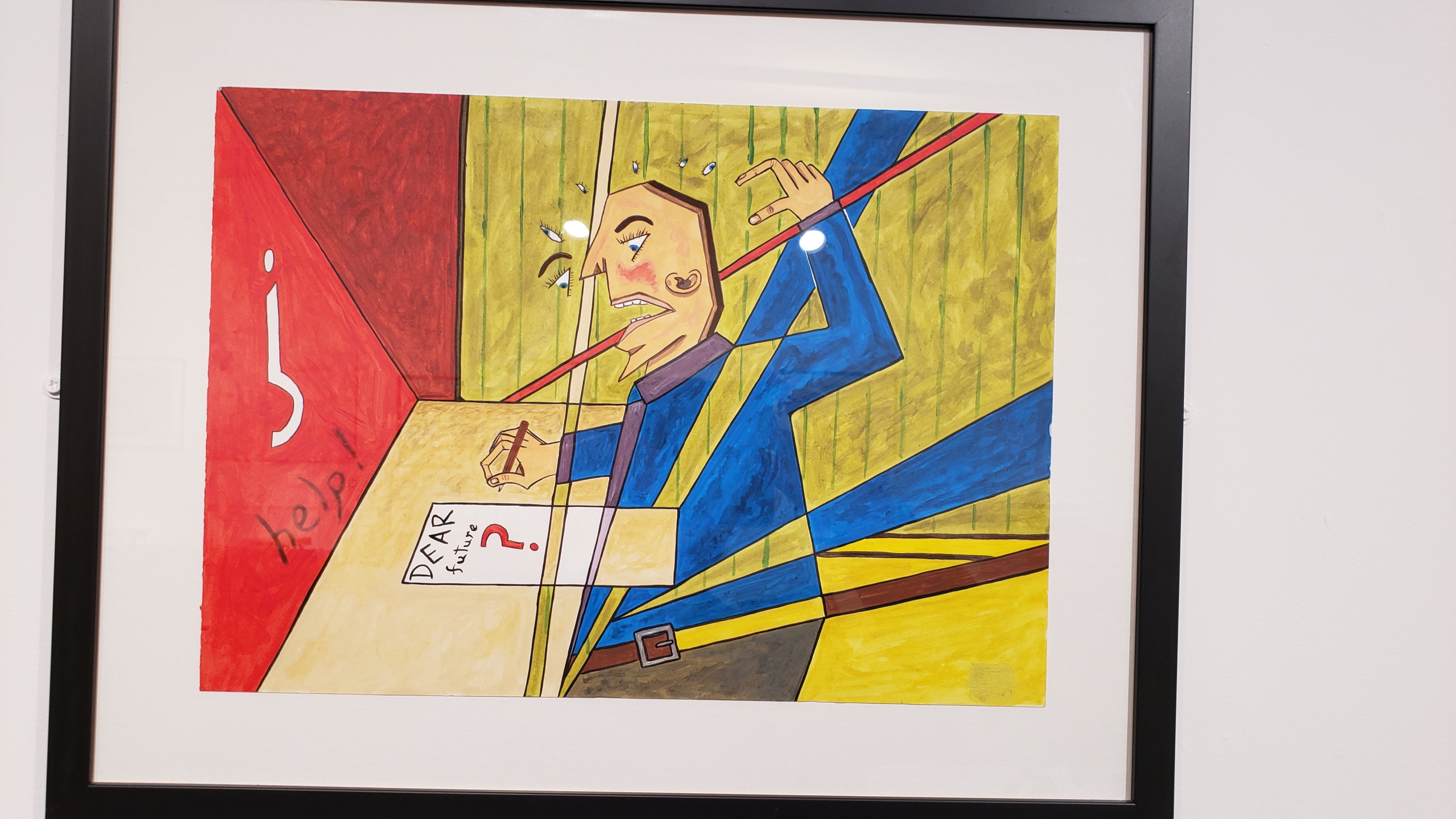
Bobby Baker is a performance artist, and quite a successful one.  Over about a decade, from 1997 to 2008, however, she battled mental illness.  During this time she filled dozens of sketch books with daily drawings and paintings as a sort of therapy.  About one or two hundred of these are on display in this exhibit, and they provide a chilling and yet affirming window into the soul of someone sick.  Here is a small sample.  I really recommend checking out the rest of the images online:

Ta!

convert this post to pdf.
Arts and Review and Travel — nic @ 25 May 2009 10:40 am

The Best Art Exhibition in London” is what I enthusiastically wrote in the guest register at Tales From The Electric Forest in the Saint Pancras Crypt Gallery. On display only until May 31st, this is a must see exhibit for anyone within the 30 boroughs. Please check out the website as well.

I visited St. Pan’s crypt last year and quite enjoyed both the space and the art. Black Apple and Cactus Productions have teamed up with 15 artists to present an exhibition of painting, photography, sculpture, mixed media, prints, etc. which embrace and embellish the special venue the crypt provides.

I knew from the first, when I saw one of Clare Palfreyman’s pieces in a small alcove in the crypt entryway

I next encountered the works of sisters Claire Benson and Amy Nightingale:

“These winged spirits seize the jewellery of human adulteresses, and leave their prizes in the bedrooms of those who have been deceived” says a small plaque. We see several more of the sisters mythical beings trapped under glass throughout the crypt. Check out their website.

There are large grey plants growing out of the rubble in another small alcove in the crypt entry, sculpture by Lizzie Cannon which looks for all the world like it is, or recently was, a living plant.

concretelandscape

thepottingtable

Other pieces by her are spread about the exhibit space.

Emma Gregory offers up a selection of screen prints including Wish You Were Here

wish_you_were_here

Katharine Fry produced a live performance for the opening, which I unfortunately missed, but left behind a mystery of flower petals graffiti and a birdcage in one of the inner crypt chambers. The graffiti, especially, caught my eye. On each of the three walls of the small central chamber the same phrase would be repeatedly scrawled. One wall read, “Every day I write your name on a piece of paper and eat it.” The next read, “One day I’ll be a murderess” and the last reads, “I count to a thousand but think of you again.”

Tom G Adriani presents us with paintings and small etchings accompanied by verse. I was particularly touched by this one, The Cat Hag:

The bedraggled form of the old cat hag

in her tattered dreaded locks

A blackened crumbling wedding dress

in a washed out Tiffany’s box

We see her every now and then

with flowers in her hair

A flash beside the motorway

or spiralling subway stairs

Pushing her shopping cart

gazing at the stars

Weaving slowly and gingerly

through lines of smoking cars

I wonder why cats follow her
I wonder where she sleeps
I wonder why when she smiles

it looks as though she weeps

Tom G Adriani – The Cat Hag

He has many other pieces up, including several large narrative pieces.

Lucy Harvey has made an installation in one of the inner chambers, The Backstreet Dentist and Other Stories

which is a little frightening, if you ask me, but captivating as well. I had the pleasure of meeting Ms Harvey during my visit, and purchased one of her booklets featuring her work.

Nazir Tanbouli has a wide selection of paintings up, including some large cubistic wall hangings in the final chambers of the crypt, which are quite stunning (I know, I know, I was saying some anti-cubism things just days ago).

Okay, I’ll stop. I just had to share my joy at having seen this show. I will be watching some of these young artists as their careers develop.

Ta!

convert this post to pdf.
Arts and Review and Theatre and Travel — nic @ 25 May 2009 05:17 am

Okay, this is The hot ticket right now, Sir Ian McKellen as Estragon and Patrick Stewart as Vladimir in the Samuel Becket classic, Waiting For Godot.

I managed to capture a returned ticket to the Sunday matinée performance, and dutifully trudged across from Covent Garden station to the Haymarket in ample time for 3:00 curtain.  I even purchased a programme, which I only rarely do.

It didn’t help.

Not much.

My review?  WTF!?

It was a brilliant performance, but I would be lying if I claimed I understood it all.  This was not a uviversal reaction.  My seatmate was in rapture throughout the piece, and explained that having read the script several times, and seeing other performances and a film version, with this staging it finally all made sense to her.

Lucky duck.

The staging was beautiful; set, lights, soundscape, all spot on.  The individual performances were all top notch.  Simon Callow brings a special brilliance to Pozzo and Ronald Pickup tackles the most difficult role of Lucky with applaum.  I must say that McKellen & Stewart’s chemistry was a special delight.

I will have to think more about this show before it all really sinks in.

Home again to a mindless night of telly.  “Britain’s Got Talent” indeed.

Ta!

convert this post to pdf.
Arts and Review and Theatre and Travel — nic @ 23 May 2009 04:34 pm

No, I am not referring to the new Joss Whedon show. I am referring to the Donmar Warehouse production of Henkrick Ibsen’s A Doll’s House, starring, amongst others, Gillian Anderson and Christopher Eccelston. She, of the X-Files and he of Dr. Who. It is all too easy to condemn these star studded productions as just gold digging by the theatres, but that is also quite often not the case at all. In this instance, we were quite well served by Ms Anderson, as Nora and Mr. Eccelston as Neil Kelman, as well as their cast-mates: Tara Fitzgerald, as Christine Lyle; Anton Lesser as Dr. Rank and Toby Stevens as Thomas.

First a word about the venue, Donmar Warehouse. In the heart of the West End, just off the 7 Dials, this is a small full thrust house, which means there is no “backstage” and the stage is surrounded on three sides by seating. I was stage right, second row, near the corner with the main bank of seats. There is a balcony, steeply raked, but this is a very intimate house. I was no more than four or five feet from the major entrances and exits of all of the major characters, and love that closeness.

It reminded me, in this way, of a performance of Another Time, produced by the American Jewish Theatre and starring Malcolm McDowell, which I saw with X in New York many years ago. It was wonderful to be so close to such a star that you could realise that they are no different than any other actor; they are only as good or as bad as their performance. An intimate theatre like this takes the air out of the “They’re only cast for drawing power” argument – if they suck the show will suck, and there is no getting away from it.

A Doll’s House is a taught show by any measure. Ibsen despised the gender roles of his era, and wrote unsympathetically of them here and in Hedda Gabler, the masterpiece for which he is most remembered. He was a wordy writer, and he wrote in his vernacular, the Victorian era vernacular of Norway. Translations of his work have often suffered the same fate as the King James Bible, in that the political and social sensibilities of the translator, or the translator’s patron, can often interfere with the intent of the work. In this new version, Zinnie Harris brings us an unforgiving Ibsen, in an accessible but still period vernacular. The rendition is marvellous for these times (and resonates particularly well given the current political climate).

On, then, to the performances. Ms Anderson is highly passionate in her role as the dutiful wife of a politician. While it may be tempting to dismiss this passion as mere cover for a poorly realised portrayal, it is, in Ms Anderson’s able reading, intrinsic to that character. We see, over the span of three acts, her channel this passion first one way and then another as she tries to find a way to defuse the central conflict of the drama.

That conflict is this: Nora, years ago, borrowed money from an unscrupulous source when her husband, Thomas, then a budding politician and now an MP and Cabinet Minister, had a nervous breakdown and she needed to take him abroad to shelter him from the public and press. Her husband knows nothing of this loan, would not have approved, and practically denies that this episode in his life ever happened. The lender, the now discredited former MP Neil Kelman, whose brief Thomas now holds, has decided that in order to save his own hide he must blackmail Nora over the loan he made to her under questionable circumstances. Add to this mix Christine Lyle, a schoolmate of Nora, who has fallen on hard times and prevails upon Nora to help get her a job, and serves as Nora’s confidant. Also Dr. Rank, an old family friend of means who has always held a flame for Nora.

What differentiates an Ibsen drama is that the core conflict in his dramas is always going to revolve around sexual politics. In this case Thomas doesn’t believe that his wife is anything more than a silly, and pretty, mouse. She is happy to let him live with this delusion, rather than let him know that they are both suited in dead people’s clothes from the charity shops.

Eccelston is a manic force in this piece, and I say that having seen most of his part with his back turned squarely to me (one risk of thrust staging). I did have the benefit of seeing his highest and best moment on the stage, his denouement and his salvation wrapped into one, with him and Ms Fitzgerald seated just arm’s reach away. It was gut wrenching and affirming at once. His breakdown in front of the audience was a sincere moment, and the tenderness and unyielding manner of Ms Fitzgerald’s Christine was masterful as well. The two of them nearly stole the show, Ms Fitzgerald’s performance as deliberate as Ms Anderson’s is passionate. They represent the two diametric extreme in Ibsen’s lexicon of the female soul.

In the final scene, between Nora and Thomas, the husband berates his wife; he declaims her, derides her, nearly disowns her. Ms Anderson’s Nora shakes and cowers under this onslaught and Thomas nearly froths at the mouth, his temples throbbing as he raises himself to his full, considerable, height. It is easy, at this moment, to wonder where is Ibsen’s strong woman? We do not see her here. But then, in a moment, there comes a flash and the tables are turned:

Thomas: First and foremost you are a wife and a mother.

Nora: No, first and foremost I am myself, I am Nora!

Anderson rises to her full height and nearly sweeps Stevens off the stage as she launches into her condemnation of him. You can watch the air go out of him, and her find her full power and true centre in this captivating and miraculous three minutes of stage time. To say a chill wind blows through Donmar Warehouse in this scene would be an understatement.

The performances in tonight’s show were all top notch. This show, with five key roles and three supporting, leaves little room for weakness. There is none here. As for Eccelston and Anderson, tonight they were not stars, they were great actors in the company of great actors, and they all shone.

Ibsen is often referred to, in the theatre world, as the father of modern theatre, for his productions were the first to demand, and receive, realistic staging and lighting. Before Ibsen, staging relied mostly on drops and lighting consisted mainly of “limelight” spots and footlights. But Ibsen’s shows had real three dimensional sets and the most modern of lighting. This emphasis on realism allowed the audience to see in the prosaic lives on stage a reflection of their own.

The British theatre, and especially the legitimate, or dramatic, stage, also has a rich tradition of realism, as I have commented before. This tradition shone here with the modest, but dominating design of Anthony Ward and the naturalistic and well motivated lighting of Hugh Vanstone. All of this under the skilled direction of Kfir Yefet.

I thought that Duet for One, after topping Madame de Sade, would stand as the best show I would see on this trip. No more, A Doll’s House has soundly taken that seat. Tomorrow brings a matinée performance of Samuel Becket’s Waiting for Godot starring Sir Ian McKellen and Patrick Stewert. They have a mighty high threshold to overcome.

convert this post to pdf.
Arts and Current Events and Pop Culture and Review and Travel — nic @ 23 May 2009 11:50 am

Having waited until most of the galleries are actually open, I’ve returned to Bethnel Green yet again to see some of the cutting edge works on display in the bevy of galleries there. First, however, I took a little trip back to Fitzrovia to check out Approach W1.

There are two Approach galleries, E2, in Bethnel Green (over the Approach Pub) and W1, in Fitzrovia, just above Oxford Circus (E2 and W1 are postal codes). I am more interested in the works of Chris Brodahl than I am in the works on display at E2.


It was a nice show, but not so much of the work really did it for me. I guess I may not be the audience for this stuff. I do like the pieces above, they are evocative of the work of Francis Bacon or some of his contemporaries. Oh well, off to stroll Oxford Street a little bit (it’s a “no traffic day” so that is made easier) and maybe shop a bit.

I end up shopping more than I want as the tube is suddenly shut for an “emergency” so I have to wait that out before finally getting into the station and on my way to the East End.

Once there I stroll up Cambridge Heath road to a few galleries Anne Redmond had clued me into. First on the list is “Look! No hands”at ¢ell Project Space, This is a group show featuring Athanasios Argianas, Kim Coleman & Jeny Horgarth and Simon Faithfull. The first piece we encounter in the darkened first storey location off the main road and back a mew is Simon Faithfull’s 1996 work, “Going Nowhere.” This is a video loop running about 9 minutes (I believe) in which the cameraman starts a video camera which is looking into the distance across the Oxfordshire landscape. It is winter and we see a snow covered field reaching to the horizon, a tree line in the distance, and an army of clouds on the march above. Once the camera starts rolling, the cameraman crosses from behind the camera and into the shot. He trudges off over the horizon over about two minutes, and leaves the camera, and us by proxy, behind.

This is the core of Simon’s work, and really this show. It is about what happens after the artist has taken their hands off of the work, hence “Look! No hands.” as the title of the show would have it. At first my reaction to Going Nowhere was, Okay, that’s enough of that… I waited, however, and started to think about the act of the artist, he has faith in his equipment and his setup and once he has got the machine started, the art machine, he just leaves it go for a while. This si either an act of hubris or one of exploration. I think it is in fact a mixture. In a way it made me think back to my days of exhibit development in a science museum. I would spend years making an exhibit, thinking it up, collaborating on design, watch it get built, etc. Then a day would come and it would go out on the museum floor. Then I could only watch to see how well it did its job as the public interacted with it.

About this time a shape appeared on the horizon and roused me from my reverie as Faithfull approached the camera again and shut it off. I guess he went nowhere, but I was left to think.

The other two rooms in the exhibit were less complex, in many ways, from the first. Kim Coleman & Jenny Hogarth provide four works, “Connect, (Venetian Blinds)”, “Connect, (hair dye)”, “Sugar Paper” and “Museum Light” all from 2008. Of these I most liked Sugar Paper which was shot from above looking down on a table covered with coloured construction paper (sugar paper) and a pair of hands move that paper about. It is projected from above onto a similar table, also strewn with sugar paper, which makes for an unnerving viewing experience as disembodied hands reach out and move the paper about, or so it appears until you look closely and realize that the real paper is stationary whilst the projected images are moving.

Venetian Blinds and Museum Light both are experiments in projecting an image of an object onto that same object (much like Sugar Paper). Venetian Blinds is the more effective of these (or else I am just too literal minded) as the projected blinds are opened and shut you almost do a double take to see if the real blinds just changed.

Lastly, Athanasios Argianas’s A demonstration of one thing as many as a demonstration of many things as one (I was swept off of my feet) is a masterfully effective piece of art. A pylon build of metal truss work rises out of a plinth in the centre of the room. Across this truss-work are three strips of white material (poster board or foam core) each about 3″ by 18″ wide and at different angles to you, one closer on the right, one on the left, the third about even. A projector fills each strip with imagry of three women, one on each strip, (one on the right, one the left, one the middle) as they start into singing rounds of a simple song. The interaction between these different planes, different strips, different coloured filters…It is quite beautiful, and I staye and watched it for more than a couple of cycles through the roughly 2 minute loop.

Okay Cell, on to monikabobinska gallery, just down the block. I needn’t have waited for them to open to see the installation piece by Sinta Tantra, for it is the paint job on the building itself. Interesting, but not really my cup of tea. Oh well. On to Vyner street and a whole bevy of galleries which dot the landscape. (Interesting sign seen on one building, “This is not a gallery!”)

Vyner Street is a few blocks of old factory and warehouse building backing on the eastern branch of the Regents Canal. There are small galleries all along the street. I stopped into all of them I could find, and as not all of them had handouts or cards, I am doubtless going to miss some.

First was Rene So at Kate MacGarry, a collection of bulbous busts which reminded me more of Pop-Art chess pieces than anything:


Again, not my style, but what the hell.

Then I crossed the street to Breaking New at Five Hundred Dollars an artist supported gallery conceived from the first to have a limited life of just a few months. This group showing consists of many artists. I will call attention to Aliki Braine for Forest (parts I – III):

forest

And Tessa Farmer for A Prize Catch (series):

aprizecatch-doormouse

There is other stuff you may like, so check out the website.

VINEspace gallery feature Your face, your race, the way you talk…I kiss you, you’re beautiful I want you to talk modern photography by Neil Drabble, Sean Fader and Oskar Slowinski. Of these easily Sean Fader’s work has the most impact on me. Neil Drabble offers us Roy, a documentary study taking place over an 8 year period and focusing almost exclusively on his subject, Roy, coming of age. It is interesting, but doesn’t really inspire any thing stronger in me. Oskar Slowinski offers us some intriguing candid street shots, but again nothing too special to me. Sean Faber, on the other hand, offers us this:


Here he is digitally manipulating images to show us him in other forms (or skins) or him in the ultimate act of narcissism. Quite effective, I thought.

Don Joint Waldameer and Chuck Webster at FRED were nice, Joint certainly a masterful collage artist, but neither grabbed me.


The Götz Füsser Studios is showing paintings by Bryan J Robinson. His small watercolours got my attention, but his featured big works seemed like someone had gutted Keith Harring over a canvas and framed the results:


Nettie Horn gallery features The Hidden Land with Gwenaël Bélanger, Daniel Firman, Ori Gersht and Lori Hersberger. Upon entering the gallery you are instantly confronted by Le Faux Mouvement (2008) by Bélanger, and it is truly stunning both in scale and for its captured moment:

The other works are quite eye catching as well. Ori Gersht’s series Falling Bird is a stunning use of photography to mount an exploration behind a classic still life by Chardin. Originally a short film shot with high definition, high speed cameras, Gersht captures the plunge of a pheasant into a dark pool of fluid, next to some grapes arranged on a shelf above the water. It is quite a series.


I am going to speed through the rest of this because this post is already too long and I want to save some space for the highlight of my trip.

A quick mention is due Alex Echo Arts who opens up his working studio on Saturdays for inquisitive (and no doubt acquisitive) art fans. I liked his complex collage work as well as his experimentation with incorporating words into his works. Check his website (link above) to see what I mean.

Dialogue at Vyner Street offers up Remnants of our past by Gerard Mannix Flynn. This installation piece features hundreds of rifle stocks and thousands of rounds of spent ammunition to try to teach us a little bit about the emotional costs of entanglements, but more importantly of disentanglements. He is referring, specifically, to the disarmament process following the Good Friday agreements which brought “The Troubles” in Northern Ireland to an end. Again, check the website (link above) to see for yourself. The thousands of rounds of ammunition scattered about on the exhibit floor made this the most interesting tactile experience of the day.

Lastly some °art, host the Signature Photography Awards 2009 show. This annual awards series honours some of DegreeArt’s crop of graduating or recently graduated student artists. I am a big fan of young artists, and fully endorse Degree’s stated mission, “Invest in the artists of the future.” There is much for these young artists to be proud of. I will bring special note to A Dream from the Posted series by Natalie Tkachuk, from the 2007 class of University College, Falmouth. Here is that piece:

Natalie Tkachuk - A Dream

Natalie Tkachuk - A Dream

This features wartime letters from Frank to Maude, and in each in the series Natalie has carefully folded the letters within the envelopes so that particular lines from them are visible through the open slit of the envelope. In this the top one says, “…a long past. I was so disappointed as I woke up to find it was only a dream.” And the bottom one reads, “I suppose I will just have to wait.”

Another piece which really struck me was Hammered (no pun intended).

hammered

Catherine Dwyer Harvey - Hammered

This homage to the classic pin-up photograph effectively addresses the power imbalance implicit in those, while having a sense of humour about it. Contrast this to those dreadfully cold and violent images by Helmut Newton I wrote about the other day. The young Catherine Dwyer Harvey is a clear winner in that competition, and she won the Singled Out Portraiture Finalist in this competition, as well. Keep you eye out for her work.

Do yourself a favour and check out °art website (link above), you will not be disappointed at the huge range of works and artists they offer.

At last finished I took a stroll through part of Victoria Park and then back on the tube. I saw this upstairs from a shop on Montmarch Street and though it looked interesting.

Ta!

convert this post to pdf.

Next Page »